Atradius Atrium
Get direct access to your policy information, credit limit application tools and insights.

 Australia
Australia
Australia
 Austria
 Belgium
 Brazil
 Bulgaria
 Canada
 China
China
 Czech Republic
 Denmark
 Finland
 France
 Germany
 Greece
 Group
Group
 Hong Kong SAR
 Hungary
 India
India
 Ireland
 Italy
Italy
 Japan
Japan
 Lithuania
 Mexico
 Netherlands
 New Zealand
 Norway
 Poland
 Portugal
 Romania
 Singapore
 Slovakia
 Slovenia
 Spain
Spain
 Sweden
 Switzerland
 Turkey
 United Arab Emirates
 United Kingdom
 United States

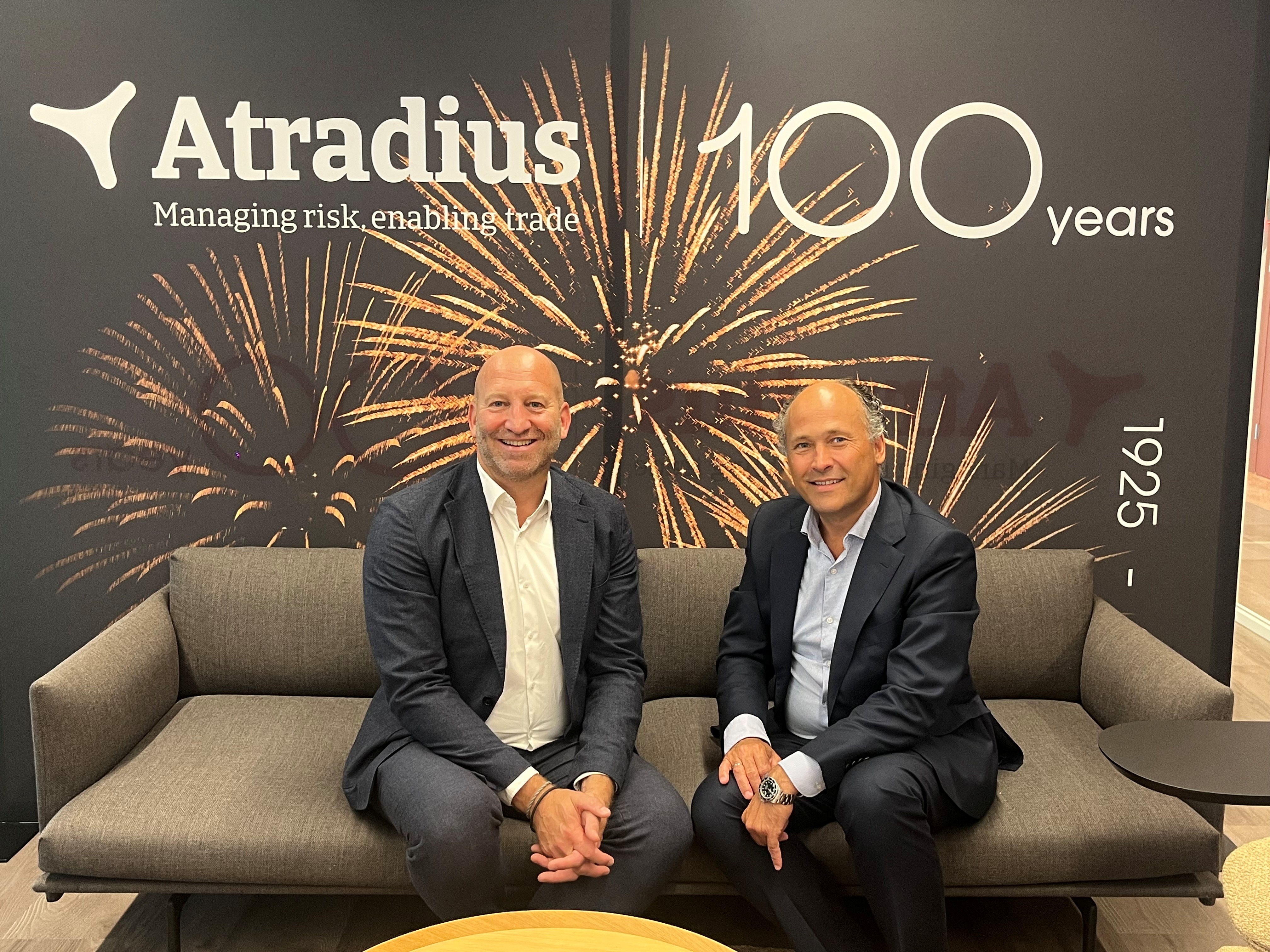
Credit risks have increased in recent years and become more interconnected and less predictable. According to Edwin Kuhlman and Rik Broekman, Risk Director and Commercial Director at Atradius Netherlands, this makes a forward-looking approach more important than ever for credit managers. But how can businesses identify potential payment problems before they arise?
To understand a customer’s ability to pay, credit managers need to look beyond traditional financial indicators. This means taking into account developments such as geopolitical tensions and shifting trade routes, while also working more closely with colleagues across the organisation. Focusing solely on annual accounts, payment patterns, and sector data may mean identifying risks too late to respond effectively.
Given all the attention paid to developments such as nearshoring and friendshoring, the idea of operating beyond borders, in its most literal sense, is more relevant than it may initially appear, say Kuhlman and Broekman. While some companies want to shorten their supply chains or outsource them to reliable partners, globalisation is not on the wane. “Of course not,” says Kuhlman. “The world is a big place, and there are still plenty of opportunities for entrepreneurs to grow and trade internationally. And entrepreneurs are creative and flexible.”
Opportunities and threats are constantly shifting, prompting businesses to explore new markets, redirect trade flows, and reduce their dependence on particular regions. Unpredictable US policies on import duties and trade restrictions attract significant public attention, although their impact varies considerably across markets and sectors. For many exporters, neighbouring markets and established trading partners remain more important than opportunities further afield. At the same time, Atradius is seeing growing interest in Southeast Asia among exporters in a range of markets.
However, this varies depending on the product and customer type. Kuhlman explains: “If you are in the flower trade, you may be less inclined to head in that direction. You will probably focus more on markets closer to home.”
A more significant factor for international trade is the fact that a wide range of risks have increased in recent years. “A great deal has happened lately,” says Kuhlman. “Think of the coronavirus crisis, Russia’s invasion of Ukraine, supply chain disruptions that were further exacerbated when the Ever Given became stranded in the Suez Canal, US trade policy and, more recently, the war in the Middle East.”
Historical financial information alone is no longer sufficient for effective credit management. If a company exports steel or metals to the US and Washington introduces new import tariffs, the credit risk faced by its business partners can change overnight.
Atradius regularly publishes articles on these developments to explain what they mean for international trade. These publications often reach a similar conclusion: geopolitical tensions, conflicts in the Middle East, trade disputes, and import tariffs can drive up prices overnight. This can lead to higher production and transport costs, lower consumption, postponed investment, and other economic headwinds, which in turn increase credit risk.
Another risk category that has grown in importance is policy uncertainty. Across many markets, businesses are facing more frequent regulatory changes, shifts in industrial policy, and evolving energy and environmental requirements. Decisions on subsidies, taxation, energy policy, or permitting can materially affect demand patterns, cost structures, and investment decisions. As a result, changes in the policy environment can quickly reshape the risk profile of entire sectors and the companies operating within them.
Cyber risk is a third category that is rapidly growing in importance. Identity fraud, fraudulent orders, and cyberattacks can suddenly plunge an otherwise healthy company into operational and financial difficulties. In recent years, several companies have been forced to shut down operations for weeks following a cyberattack. The effects can also be felt further along the supply chain, including by suppliers.
Together this creates a more complex risk environment. Risks have become more unpredictable, more numerous, and more closely intertwined than in the past.
In practice, this has significant implications for credit managers. In the past, they could often assess risk based on a company’s country, sector, balance sheet, and profit and loss account. Today, historical financial information alone is no longer sufficient for effective credit management.
“If a company exports steel or metals to the US and Washington introduces new import tariffs, the credit risk faced by its business partners can change overnight,” says Kuhlman. Credit managers would therefore be well advised to look beyond borders and beyond limited historical financial data.
Credit managers need to proactively consider the potential consequences of a wide range of developments. Are higher costs being passed on to customers? Have trade flows shifted? Has the customer found alternative markets? Which sectors do this company’s customers depend on?
Credit management therefore needs to become more strategic. As credit risks become harder to predict, it is increasingly important for credit managers to strike the right balance between risk and opportunity. This also requires a more proactive approach. For years, credit management has been shifting away from collecting overdue invoices and towards preventive measures aimed at avoiding default in the first place. Kuhlman and Broekman believe this trend will continue in the years ahead.
“Credit managers need to proactively consider the potential consequences of a wide range of developments,” says Broekman. “For example, are higher costs being passed on to customers? Have trade flows shifted? Has the customer found alternative markets? Which sectors do this company’s customers depend on?”
AI can do a lot, but it cannot analyse the information that is in that customer’s head. A conversation can reveal cancelled orders, slower customer payments, and expectations for the months ahead, information that rarely exists as structured data.
This information is often not publicly available. Personal contact with customers and potential customers is therefore becoming more important, even in this age of AI. A conversation can reveal cancelled orders, slower customer payments, and expectations for the months ahead, information that rarely exists as structured data. “AI can do a lot,” says Kuhlman, “but it cannot analyse the information that is in that customer’s head.”
For the credit manager, ‘beyond borders’ also means working closely with other departments across the organisation. Credit managers are naturally well placed to act as a connecting link, say Broekman and Kuhlman. Credit management sits at the intersection of sales, finance, and operations. Unpaid invoices may indicate a liquidity problem on the customer’s side, but they may also point to a disagreement over delivery, quality or agreed terms.
“If there’s one place where you are likely to hear first about quality issues with your product, it is often through unpaid invoices,” says Broekman. Credit managers can pass these signals on to sales, marketing, finance, and operations, helping to improve operational performance and strengthen customers’ willingness to pay. In this way, the credit manager evolves from an administrative guardian into a strategic adviser.
The credit insurer can play an important role in that process. After all, Atradius does not look at a single debtor or sector in isolation, but considers countries, sectors, and trade flows in a broader context. This wider perspective helps identify signals that an individual company might otherwise miss.
We have diversified our risks widely. We operate in all kinds of countries and across all sorts of sectors, offering cover across a broad range of markets.
“We have diversified our risks widely,” says Broekman. “We operate in all kinds of countries and across all sorts of sectors, offering cover across a broad range of markets.” This diversification not only enables Atradius to take on credit risks associated with individual companies. It also helps identify patterns that an individual company might be less likely to spot. These may include deteriorating payment behaviour in a particular sector, growing pressure in a specific region, or signs that a buyer is paying other suppliers more slowly or less reliably. In this way, Atradius can help keep customers informed about the credit risks they face.
When major developments occur, such as new import tariffs or geopolitical tensions, Atradius quickly produces economic analyses. “Our economic research department is usually quick to assess the consequences, including the impact on trade flows,” says Kuhlman. “These reports draw on insights from multiple countries and perspectives to support our customers around the world.”
Credit limits are where this information becomes most tangible for businesses. A credit limit is the amount of risk that Atradius is willing to cover in the event of non-payment by a customer’s buyer. “We continue to monitor credit limits and adjust them where necessary,” says Kuhlman. “An adjustment to a credit limit is a signal. It means that, in our view, something has changed in that buyer’s risk profile. It can therefore help businesses identify both opportunities and risks.”
This article is based on an interview originally published by Credit Expo, a Dutch credit management publication, and has been adapted for an international audience.
To explore how to strengthen your own credit risk strategy, get in touch with us and see how we can help you stay ahead.
Credit risks are becoming more interconnected, unpredictable, and difficult to assess through financial information alone
Geopolitical tensions, regulatory changes, and cyber threats can alter a company’s risk profile almost overnight, creating new challenges for credit managers
As risks become more complex, credit management is moving beyond collections and credit checks; credit managers increasingly act as strategic advisers, combining financial analysis, customer intelligence, and cross-functional collaboration to help businesses anticipate problems and support growth
By monitoring payment behaviour, sectors, and markets across multiple countries, Atradius can identify emerging patterns that individual businesses may miss. Through economic insights and credit limit decisions, it provides practical signals that help companies recognise both risks and opportunities earlier.


